Tag Archives: How-To

Remove Proudly Powered by Wordpress Thumbnail

Remove Proudly powered by WordPress Theme and Replace with Your Own © Copyright Information

WordPress Theme users, let’s remove “Proudly powered by WordPress” from the footer of your website. It’s pretty simple. A line of CSS would do the job.

Remove “Proudly powered by WordPress” on Twenty Sixteen, Twenty Seventeen, Twenty Nineteen, Twenty Twenty-One Theme

Open Up the CSS Editor:
(Go to the Backend page -> Appearance -> Editor)

footer .site-info { 
 display: none !important; 
}
footer.site-footer:after {
 content: "© YOUR WEBSITE NAME";
}

Replace YOUR WEBSITE NAME as you like.

footer.site-footer:after {
 content: "© YOUR WEBSITE NAME";
 margin: auto;
}

If you want to center align the Copyright line, add margin:auto like below:

Remove “Powered by WordPress” on Twenty Twenty Theme

Open Up the CSS Editor:
(Go to the Backend page -> Appearance -> Editor)

.powered-by-wordpress {
    display: none;
}

Remove “Proudly Powered by WordPress” on Twenty Twenty-Two Theme

Open Up the CSS Editor:
(Go to the Backend page -> Appearance -> Editor)

.has-text-align-right {
    display: none;
}

Now it’s all good!

Storefront

Remove “Storefront designed by WooThemes” on Woocommerce Storefront Theme

Get Custom Phone Case Now!

Woocommerce offers a well designed free template for everyone called, the Storefront. By adding the CSS codes below, you can remove the credits, “Storefront designed by WooThemes” without editing or deleting a line of the core programmings. So instead of deleting anything, you are just hiding the text actually. So it’s a risk free, easy and fast!

Remove “Storefront designed by WooThemes” Credits

Place the CSS line on the WordPress backend where CSS is located:
(Go to the Backend page -> Appearance -> Editor)

footer .site-info { 
 display: none !important; 
}
footer .col-full:after { 
 content: "© YOUR COMPANY NAME";
 font-size: 15px;
 color: #777;
 line-height: 140%;
 text-align: center;
 display: block;
 margin: 20px auto;
}

Now you’ll see the line, “Storefront designed by WooThemes” is gone. Feel free to edit the font-size and color of your own.

JavaScript Redirect

Simple JavaScript Redirect Code for HTML

Here’s the one of the simplest ways to redirect your site’s traffic.

Redirect to Different URL

Copy the code below and paste it to your blank html.

<script language="javascript">
window.location.href="http://YOUR-REDIRECT-PAGE"
</script>

*Replace YOUR-REDIRECT-PAGE with your new URL.

Storefront

Remove Product Description and Reviews Tabs in Woocommerce Storefront Theme

Wocommerce offers the tabs: “Product Description”, “Reviews and/or “Additional Information” in the product detail page. Let’s find a way to remove or disable the tabs while you are using in the “Storefront” theme.

Remove “Product Description”, “Reviews” and “Additional Information” Tabs

Go to the backend -> Appearance -> Editor -> Find “storefront-functions.php” on the right. Input below code in the very bottom. “Update File” after adding the codes.

add_filter( 'woocommerce_product_tabs', 'woo_remove_product_tabs', 98 );

function woo_remove_product_tabs( $tabs ) {

unset( $tabs['description'] ); // Remove the description tab
unset( $tabs['reviews'] ); // Remove the reviews tab
unset( $tabs['additional_information'] ); // Remove the additional information tab

return $tabs;

}

If you wish to keep one or two of the three tabs, just remove the corresponding line from the codes. Enjoy woocommerce!

HTTPS thumbnail

Resolved! Loading Your Google Fonts Over https (SSL) Sites

I couldn’t believe how amazingly simple it was! I was searching for days and nights how to make my google fonts properly load over on my WordPress https (SSL) site.

Here’s the basic story. I’m running an e-Commerce store with a Secure Sockets Layer installed on the domain. I created the logo with “La Belle Aurore” font from Google. When customers pay for their purchase, they have to land on the cart page showing https. My logo won’t be properly showing when my customer uses IE (Internet Explorer 11) browsers or my Safari from iPhones, so I really had resolve this issue.

I’ve seen some people trying to resolve the issue by creating weird code in the .htaccess file or tweaking the .function file in WordPress theme. I’ve tried it, but none of them actually worked for me.

Ta-Dah! It was simpler than I thought. I deleted the http: part on my CSS file, and it worked like magic! So DO “//fonts.googleapis.com/css?family=XXX”, NOT “http://fonts.googleapis.com/css?family=XXX”

@import url(//fonts.googleapis.com/css?family=NAME_OF_YOUR_FONT_FAMILY);

I used “La Belle Aurore” font on my site, so here’s what I have. @import url(//fonts.googleapis.com/css?family=La+Belle+Aurore); I hope this method save your time as well. Good luck!

mailchimp

Quick Start Guide to MailChimp for WordPress

This post will be a quick start guide to MailChimp for WordPress plugin. You might use it to collect massive email data from the visitors of your website in order to send a blast of email for your personal or commercial needs. For beginners, MailChimp is a great place to start with your email campaign where that is available to “send 12,000 emails to 2,000 subscribers for free”.

  • 1

    Download the MailChimp for WordPress Plugin. https://wordpress.org/plugins/mailchimp-for-wp/ or go to your WordPress Admin -> Plugins -> Add New -> (Search for) MailChimp for WordPress -> Download & Activate.

  • 2

    Sign up MailChimp website for free. http://mailchimp.com/

  • 3

    Create and name your list. Go to the ‘List’ menu on the sidebar. Create a list.

  • 4

    Go to your name at the top of the sidebar and select ‘Account’.

  • 5

    Create API Key. On the top menu click ‘Extras’ -> API keys -> ‘Create A Key’

  • 6

    Copy the API Key you just created and Paste it onto your ‘MailChimp for WP’ (your WordPress Admin -> MailChimp for WordPress -> MailChimp Settings) then ‘Save Changes’

  • 7

    Check and make sure you see ‘CONNECTED’ sign on ‘MailChimp API Settings’. Click on the button -‘Renew MailChimp lists’

  • 8

    Go to the admin -> ‘MailChimp for WP’ -> ‘Checkboxes’ and check on the ‘MailChimp Lists’ box and save.

  • 9

    Go to the admin -> ‘MailChimp for WP’ -> ‘Forms’and check on the ‘Lists this form subscribes to’ box and save.

  • 10

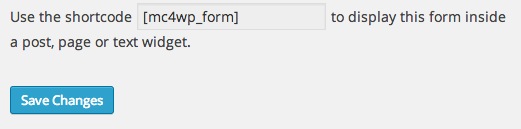
    On the ‘Form’ setting page, copy the form shortcode below ‘Form mark-up’ and paste into any posts or pages you want to show your subscriber form, or you can use a MailChimp form widget to subscribe emails. (For widget users, go to the admin -> drag and drop ‘MailChimp Sign-Up Form’ to your widget sidebar.

  • Screen Shot 2014-10-13 at 12.37.18 AM

  • 11

    Test your email. Once you actually test subscribing with your email, you would get a successful message “Thank you, your sign-up request was successful! Please check your e-mail inbox.”, but if miss any steps from above, you might see a message “oops. Something went wrong. Please try again later.”

Enjoy the MailChimp for WordPress plugin / widget!

Responsive

Responsive Google Adsense is Easy!

We are facing a big transition in web design. In recent days, majority of well developed websites are made in responsive websites. Responsive design is the development responding to the environment based on screen size of a device. That being said the content elements must evolve to meet the technology as millions of bloggers are using Google Adsense technology to monetize their content.

Below is the HOW-TO guide to tweak the current Google Adsense code with the new responsive Google Adsense banners on your site. You don’t need to have a deep understanding of it’s frame work. Here’s an easy way to make it happen.

Our DEMO is here. Just look at the header section of this site. Do you see a wide horizontal banner (728 px x 90 px)? Try resize the browser to make it smaller and reload the page. Try even smaller like you are using a mobile and reload the page. Do you see the size of the ad is changing as it’s responding?

Let’s first take a look at your current Google Adsense Code below. You can get this code from Google Adsense Site → My ads (top menu) → “Get Code” from one of your ad unit.

Make sure you select “asynchronous” code type from the drop down menu.

<script async src="//pagead2.googlesyndication.com/pagead/js/adsbygoogle.js"></script>
<!-- NAME OF YOUR AD -->
<ins class="adsbygoogle"
     style="display:inline-block;width:728px;height:90px"
     data-ad-client="ca-pub-8255226778912403"
     data-ad-slot="1054112722"></ins>
<script>
(adsbygoogle = window.adsbygoogle || []).push({});
</script>

1. You simply add a <div> around it.
2. Named the class to responsive-ad on the <div>
3. Added the class responsive-ad to <ins>. So it’s now adsbygoogle responsive-ad.
4. Changed the style to display:block
5. You must replace data-ad-client numbers and data-ad-slot numbers with yours..
6. Added data-format="auto" before closing </ins> tag.
7. Add <style> tags. You can tweak it whatever you want.

<div class="responsive-ad">	
<script async src="//pagead2.googlesyndication.com/pagead/js/adsbygoogle.js"></script>
<!-- NAME OF YOUR AD -->
<ins class="adsbygoogle responsive-ad"
     style="display:block"
     data-ad-client="ca-pub-XXXXXXXXXXXXXXXX"
     data-ad-slot="XXXXXXXXXX"
     data-format="auto"></ins>
<script>
(adsbygoogle = window.adsbygoogle || []).push({});
</script>
</div>

<style type="text/css">
.responsive-ad { width: 320px; height: 50px; margin: 0 auto; }
@media (min-width:480px) { .responsive-ad { width: 468px; height: 60px; } }
@media (min-width:768px) { .responsive-ad { width: 728px; height: 90px; } }
</style>

The <style> above has set a minimum of 768px (and up) for desktops, a minimum of 480px (and up but below 768px) for tablet, and 320px (and up but below 480px) for mobile. You may feel free to change the numbers of min-width: as your site structure.

Enjoy your blogging and monetizing with the new Responsive Google Adsense!

trash

How to Remove or Uninstall Plugins like Phantasm in Adobe Illustrator?

Get Custom Phone Case Now!

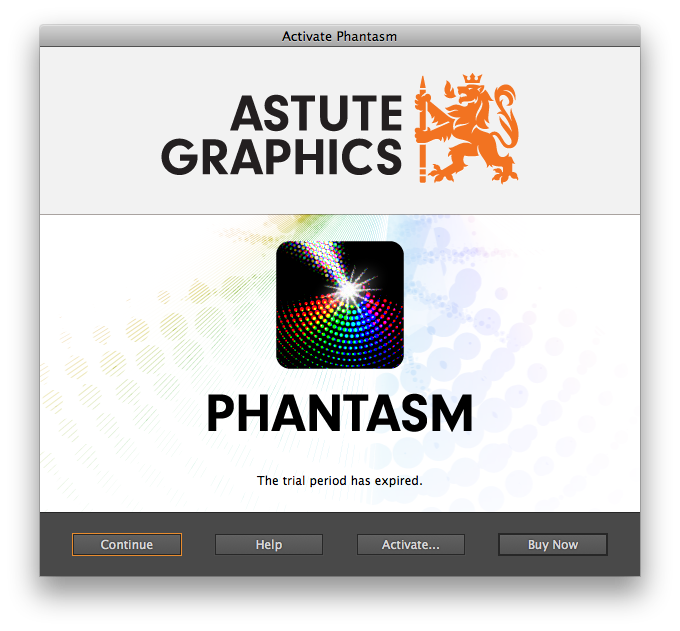
Plugins are great for Adobe Illustrator. There are many open shared plugins and it’s free to use. But sometimes a plugin has a trial period for 15 to 30 days, and it asks you to pay for the software and you just don’t want to purchase it, like Astute Graphics in my case (It’s a great plugin and would recommend to use, but for me, I found a way to change group of hue adjustments with my Adobe Illustrator CC built-in function so I no longer needed the plugin). When the trial period has expired, a pop-up window shows up every time when I open Adobe Illustrator, like this, and it’s a bit annoying:

Astute Graphics Phantasm

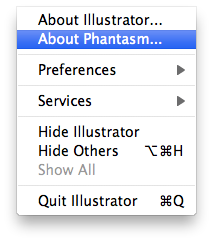
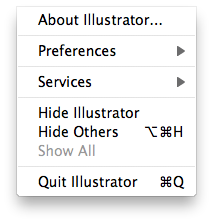
After you’ve select the ‘continue’ button, you can check to see the Phantasm plugin has been installed to your system by going to the top menu ‘illustor’ -> ‘About Phantasm’.

About Phantasm

Let’s close the Adobe illustrator by go to the top menu ‘Illustrator’ -> ‘Quit Illustrator’.

Okay, here’s what you should do to remove/uninstall the plugin:

1. Go to Applications folder: Finder -> Go -> Applications (or Shift + Commend + A)

Trash the Plugin

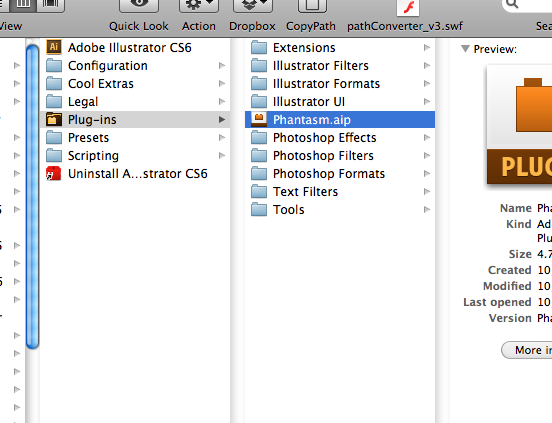
2. Go to Adobe Illustrator -> Plug-ins -> Trash ‘Phantasm.aip’ the plugin.

Done!

Top menu

Go and open Adobe Illustrator and check if the plugin has been removed completely by going to the top menu ‘illustor’ (you won’t see ‘About Phantasm’ anymore).

WordPress

A Simple Way to Hide Featured Image inside Post with CSS

Here’s a very simple way to hide your featured image inside your post area, and it does NOT affect your actual featured image on your site’s front-page or the thumbnail image from the list. You are not deleting anything but simply hiding!

This post was originally for the theme “TwentyTwelve”, however, as many people have asked about other recent themes, I have organized the codes for the default WordPress themes from “Twenty Twelve” to “Twenty Sixteen”.

For Twenty Twelve

Copy the code below and paste into your CSS document.

.attachment-post-thumbnail { display:none; }

For Twenty Thirteen

Copy the code below and paste into your CSS document.

.entry-thumbnail { display:none; }

For Twenty Fourteen

Copy the code below and paste into your CSS document.

.post-thumbnail { display:none; }
.site-content .hentry.has-post-thumbnail:first-child { margin-top: 48px; }

For “Twenty Fourteen” theme, the margin of the top header gets weird after hiding the featured image. Adding the second line, margin-top: 48px will fix the issue.

For Twenty Thirteen

Copy the code below and paste into your CSS document.

.post-thumbnail { display:none; }
.hentry.has-post-thumbnail { padding-top: 8.3333%; }

For “Twenty Fourteen” theme, the margin of the top header gets weird after hiding the featured image. Adding the second line, padding-top: 8.3333% will fix the issue.

For Twenty Sixteen

Copy the code below and paste into your CSS document.

.post-thumbnail { display:none; }

For any questions, please leave a comment. Enjoy blogging!

Joomla to Wordpress

Migrating Joomla to WordPress

Here’s the a way to migrate Joomla users to WordPress users. I’ve used Joomla for some years and I still thinking it’s a great Content Management System. But however, I’m so much liking using WordPress for my site building I definitely needed to bring users from Joomla to WordPress. If you have hundreds of articles and migrating one from another it’s pain but still possible and manually doable, but when migrating users data, it just can’t.

I’ve tried to follow other tutorials, but for some reason it didn’t work out for me. So I’ve done some other testings and finally it worked out! Now, let me introduce to how to migrate Joomla users to WordPress users. The versions I’ve used is Joomla 1.5 to WordPress 3. Here’s how as simple as:

1. On your Joomla site, export users to a CSV file.

To export Joomla users data, use ‘ARRA User Export Import’ plugin.

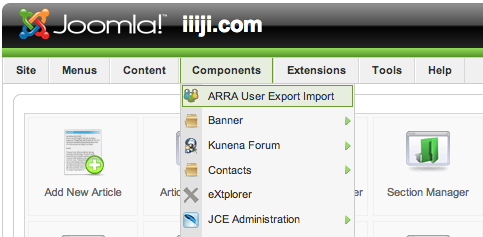
  • Install plugin and go to the plugin page (Admin – Components – ARRA User Export Import)
    Joomla Components
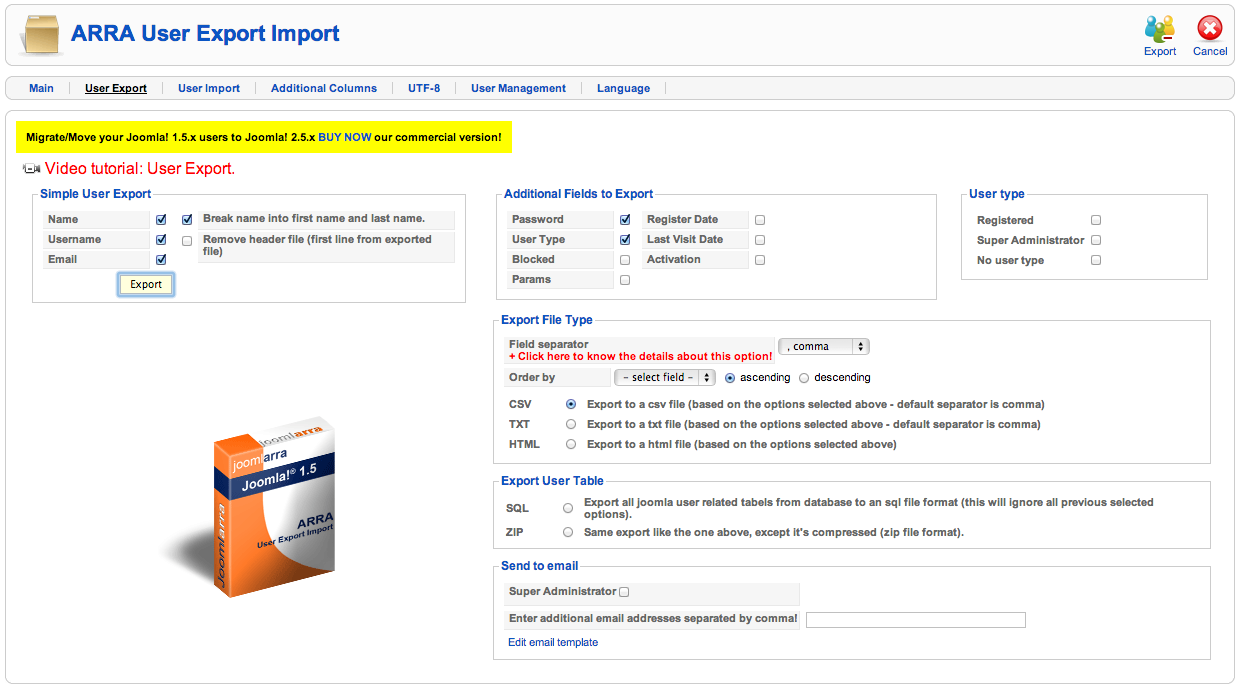
  • Click on ‘User Export’, mark the following check boxes, and “Export”!
    ARRA User Export Import
  • You’ll get a “CSV” file.

2. Tweak the CSV file before import to your WordPress site.

  • You can open the file with Dreamweaver, Microsoft Excel, or one of the text editors you already have.
  • Just need to change very top row.
    Modify from Text EditorEdit text as the following table (Top to Bottom) and save.

    first name last name username email password usertype
    first_name last_name user_login user_email joomlapass role

    *Sometimes Microsoft Excel won’t save it right. I recommend Dreamweaver.

3. Import the CSV file to your WordPress site.

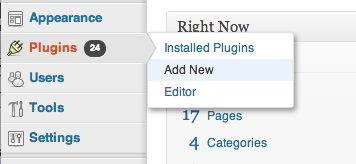
  • To install plugin, on your wordpress site, go to Admin – Plugins – Add new.
    Wordpress Plugin
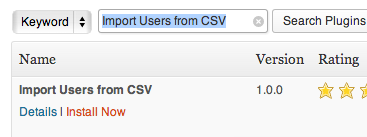
  • Search for ‘Import Users from CSV’,
    Import Users from CSV
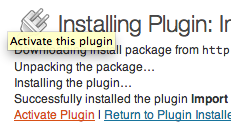
    ‘Install Now’, and ‘Activate Plugin’.
    Activate Plugin
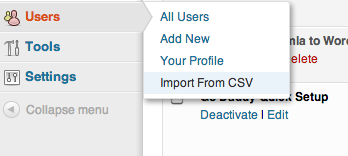
  • Go to ‘Users’ – ‘Import from CSV’
    Import From CSV
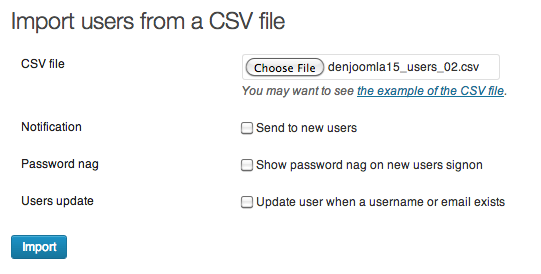
  • Drag your updated ‘.CSV’ file to the ‘Choose File’ filed, “Import”!
    Import users from a CSV file
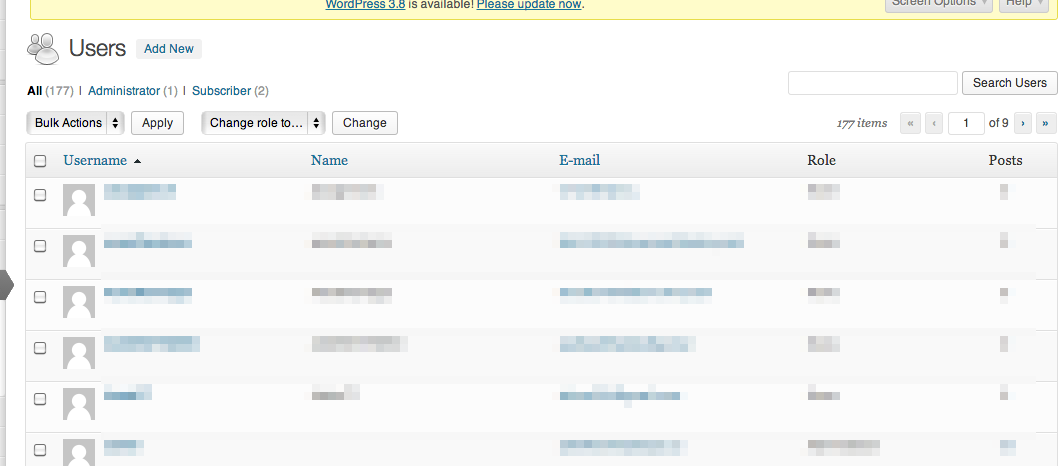
  • Check your ‘Users’ – ‘All Users” page to see everything looks right!
    Check Users page